
- What Changes When a Move Crosses State Lines
- How Long Distance Movers Build a Price
- Binding, Non-Binding and Not-to-Exceed Estimates
- How to Vet Long Distance Movers Before You Pay a Deposit
- Delivery Windows and Why Your Shipment Arrives After You Do
- Valuation Coverage Is Not Insurance
- Packing: Where DIY Pays and Where It Backfires
- Warning Signs Worth Walking Away From
- A Realistic Timeline for a Long-Distance Move
A local move is a long day. A move across state lines is a project — one with a federal regulator, a certified weight ticket, a contract most people sign without reading, and a delivery date that is usually a range rather than a promise. Almost all of the money lost on an interstate relocation is lost before the truck ever pulls away: in a vague estimate, an unverified license number, or a valuation box ticked in a hurry on load day.
None of that is complicated once you know where to look. This guide covers how interstate pricing is actually assembled, the three types of estimate and which one leaves you exposed, how to check a carrier properly in about ten minutes, what a delivery window really means, and the handful of red flags that should end a conversation.
What Changes When a Move Crosses State Lines
Within a single state, household moves are usually billed by the hour and regulated at state level. The crew arrives, the clock starts, the clock stops. Cross a state line and almost every assumption changes.
Interstate household goods moves fall under federal rules administered by the Federal Motor Carrier Safety Administration, part of the US Department of Transportation. A company that legally moves your belongings across state lines holds a USDOT number and motor carrier operating authority — the MC number you will see quoted alongside it. Those two numbers are public, searchable, and the fastest way to separate a real carrier from a website.
Three other things change at the same time:
- Pricing switches from hours to weight and distance. How long the crew takes stops being the meter. What your shipment weighs, and how far it travels, becomes the meter.
- Your shipment may not have the truck to itself. Unless you pay for a dedicated or exclusive-use truck, a household of furniture usually travels consolidated with other shipments, which is what makes long-haul moving affordable and also what makes delivery a window rather than a date.
- Paperwork becomes the record. The bill of lading is the contract. The inventory sheet is the evidence. Disputes about a scratched sideboard are settled by what those two documents say, not by what anyone remembers.
How Long Distance Movers Build a Price
Interstate quotes look opaque because they are built from several separate components rather than one rate. Once you can see the components, comparing two bids becomes straightforward.
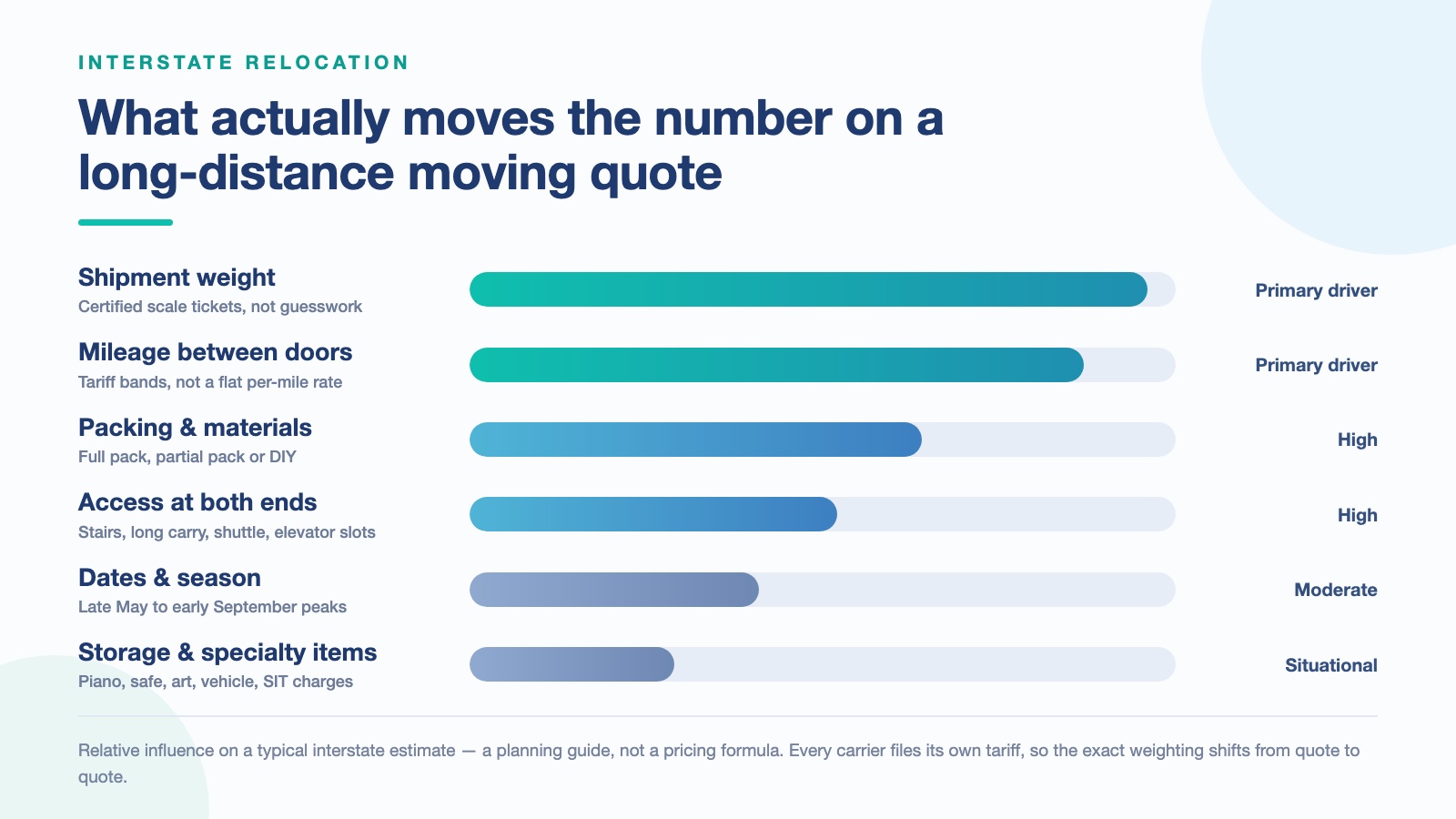
Weight is the foundation. On a legitimate interstate move, weight is established with certified scale tickets: the truck is weighed empty (tare) and again loaded (gross), and the difference is your shipment. You are entitled to see those tickets, you may observe the weighing, and if the number looks wrong you can request a reweigh before charges are finalized. Any company quoting household goods by cubic feet rather than pounds should be treated with suspicion — volume is far easier to inflate on the day, and it is one of the oldest tactics in the rogue-mover playbook.
Mileage is the second lever, though it rarely works as a flat per-mile figure. Carriers price from published tariffs with distance bands, which is why a 900-mile move is not simply three times a 300-mile move.
Packing and materials is the component with the widest spread between quotes. A full pack, where the crew boxes everything down to the contents of your kitchen drawers, is a genuine service with a genuine cost. A partial pack covering only fragile items sits in the middle. Doing it yourself is cheapest, with one caveat covered further down.
Accessorial charges are the ones that surprise people, because they depend on the buildings rather than the belongings:
- Long carry — when the truck cannot park within a set distance of the door
- Stair carry — charged per flight above an included allowance
- Shuttle service — when a tractor-trailer physically cannot reach the address and a smaller truck has to ferry the load
- Elevator carry and booked service-lift windows in managed buildings
- Bulky article charges for pianos, safes, gun cabinets, hot tubs, treadmills
- Storage-in-transit (SIT) when the destination is not ready, commonly capped at around 90 days before it converts to ordinary warehouse storage under different liability terms
Shuttle fees are worth raising specifically. Narrow residential streets, low branches, tight urban blocks, gated communities and permit-restricted parking all trigger them, and a shuttle added on the day of a move is an unpleasant surprise. Describe both addresses honestly during the survey and ask directly whether a shuttle is likely.
Timing is the lever you control for free. Demand concentrates between late May and early September, and again at the start and end of every month when leases turn over. A mid-month move in October is a different market from the last Friday in June.
Binding, Non-Binding and Not-to-Exceed Estimates
This is the single most important paragraph in any moving contract, and it is the one most people skim.
A non-binding estimate is a good-faith projection. Final charges are calculated from actual weight and services performed, so the number can move in either direction. Federal rules limit the immediate damage: at delivery the carrier cannot require you to pay more than 110% of a non-binding estimate, with any legitimate remainder billed afterwards. That protects your delivery day; it does not protect your budget.
A binding estimate fixes the price for the inventory listed on it. That is genuine certainty, with one condition — it binds the list, not the house. Add a bookcase and a bicycle on load day and the carrier is entitled to revise the figure or write a new estimate.
A binding not-to-exceed estimate, sometimes sold as a guaranteed price, is the option that favors the customer. The quoted figure becomes a ceiling: if the shipment weighs less than surveyed, you pay the lower actual cost; if it weighs more, the ceiling holds. When a carrier offers one, take it seriously.
Whichever type you sign, the estimate is only as good as the survey behind it. A proper survey — in person or by video — should cover every room, plus the garage, attic, basement, shed and anything already in storage. The most common cause of a blown estimate is not dishonesty on either side; it is the forgotten twenty boxes in the loft.
How to Vet Long Distance Movers Before You Pay a Deposit
Checking a carrier properly takes about ten minutes, and it eliminates the overwhelming majority of problems people write angry reviews about.
Start with the numbers. Take the USDOT and MC numbers from the company’s own website and look them up in the FMCSA’s public records. You are checking that the registration is active, that the operating authority covers household goods, that the legal name matches the name on your quote, and that insurance is on file. A company that will not give you those numbers has answered the question.
Next, establish whether you are speaking to a carrier or a broker. Brokers arrange moves and sell the job to a carrier who actually owns trucks. They are legal, they must be registered as brokers, and some are perfectly good — but the crew that shows up will work for a company you have not vetted, and accountability gets diffuse when something goes wrong. Ask plainly: does your own crew load my shipment, does your own driver take it, and whose truck is it? Vagueness is an answer.
A regional carrier that publishes its credentials openly is much easier to verify than a brand that exists only behind a lead-capture form. Boston-based long distance movers Better Life Moving, for example, list their USDOT and MC numbers at the top of the page, run GPS-tracked trucks along the East Coast corridor and into markets such as Chicago, Los Angeles and the Carolinas, and offer secure storage for the gap when a new place is not ready on the day the truck arrives. Those are exactly the details worth checking, asking about and getting written into the paperwork with any company you shortlist.
Then compare like with like. Send the same inventory to three carriers. Different inventories produce different weights, different weights produce different prices, and the cheapest bid in a set of three is very often the one built on the smallest list. Before you sign, get answers to these:
- Is this estimate binding, non-binding, or binding not-to-exceed?
- What is the delivery spread in days, and what triggers it starting?
- Which accessorial charges could apply at either address, and how much are they?
- Is a shuttle likely at pickup or delivery?
- What valuation options are offered, and what does the upgrade cost?
- What deposit do you require, and is it refundable if I cancel?
- Who employs the loading crew and the driver?
- How are claims filed, and what is your average settlement time?
On deposits: a modest booking deposit is normal. A demand for a large share of the total in cash or by wire, well before load day, is not.
Delivery Windows and Why Your Shipment Arrives After You Do
Long-haul household shipments are quoted with a delivery spread — a range of days, agreed in advance and written onto the bill of lading. A short in-region haul might carry a spread of a few days. A cross-country move can carry one to two weeks or more.
The spread exists for structural reasons, not evasive ones. Consolidated loads wait for enough freight to run efficiently. Drivers work inside federally limited hours of service. Weather, road closures and other customers’ access problems all move the schedule. A carrier who promises an exact date on a 2,000-mile consolidated move is either selling you a dedicated truck, which costs considerably more, or telling you what you want to hear.
Plan around it rather than hoping against it:
- Travel with a two-week kit — clothes, chargers, medication, work equipment, basic kitchen items.
- Ship a box or two ahead to the new address if you have access to it.
- Keep an air mattress and bedding out of the shipment, or budget for a short hotel stay.
- If the arrival date is genuinely fixed, price expedited or exclusive-use service and decide whether the certainty is worth the premium.
- If your new place will not be ready, arrange storage-in-transit in advance rather than negotiating it while a loaded truck waits.
Valuation Coverage Is Not Insurance
Two options appear on nearly every interstate contract, and the difference between them is large enough to reshape the whole move.
Released Value Protection is included at no additional charge and pays a maximum of 60 cents per pound per article. That is not a typo, and the arithmetic is brutal: a 50-pound television is worth $30 under this option, whatever you paid for it. It is a liability floor, not compensation.
Full Value Protection makes the carrier responsible for repairing a damaged item, replacing it with one of like kind and quality, or settling in cash. It costs extra, the price varies with the declared value of the shipment and the deductible you choose, and items of extraordinary value — jewelry, collections, certain art — usually have to be listed specifically to be covered at their real worth.
Note the vocabulary. Neither option is insurance. Both are carrier liability, set by federal rules rather than by an insurance policy. Most homeowners and renters policies do not cover household goods while they sit in a carrier’s custody in transit, so if you want true insurance you buy it separately from a licensed provider. Check your own policy before assuming you are covered.
If something does go wrong, the timeline matters. You generally have nine months from the delivery date to file a written claim. The carrier must acknowledge it within 30 days and pay, decline or make a firm offer within 120 days. Photographs taken before load day and notes written on the inventory at delivery are what turn a claim into a settlement.
Packing: Where DIY Pays and Where It Backfires
Packing yourself saves real money, and for most of a household it is the right call. Books, linens, clothing, toys, kitchenware that is not fragile — none of that needs a professional.
The caveat is worth knowing before you decide. Cartons packed by the owner are marked PBO on the inventory, and a carrier’s liability for what is inside a box it did not pack is limited unless the carton itself shows obvious external damage. Pack a mirror badly in your own box and the loss is usually yours. That is the trade you are making, and it points to a sensible middle path: pay the crew to pack the things that break and are expensive to replace — televisions, mirrors, framed art, glass shelving, lamps, china — and handle the rest yourself.
Then there is the purge, which on a long-distance move is not a tidiness exercise but a financial one. You are paying to transport weight across the country. Books are heavy. Old exercise equipment is heavy. A tired sofa that will not suit the new place is heavy. Weigh a few boxes on a bathroom scale, multiply, and the cost of moving things you do not want becomes uncomfortably concrete. Sell, donate or dispose of them before the survey, not after — the estimate is built on what the surveyor sees.
Warning Signs Worth Walking Away From
Rogue operators are a small minority of the industry, but they concentrate in the same places every year: cheap online quotes, peak-season desperation, and last-minute bookings. The signals are consistent.
- A firm price given over the phone or by web form with no survey of any kind
- Household goods quoted by cubic feet instead of weight
- A large deposit demanded in cash, by wire or by app payment
- No USDOT or MC number, or a registered legal name that does not match the company you are talking to
- No physical business address, only a call center and a form
- A bill of lading or inventory presented blank or half-completed on load day
- An unmarked rental truck arriving for a move booked with a national-sounding brand
- Heavy pressure to sign today because the price expires tonight
- Reluctance to provide the FMCSA consumer booklets that interstate movers are required to give you
One specific scenario deserves naming. If a driver arrives at delivery and demands a sum well beyond what was agreed before unloading, that is a hostage-load situation, and it has clear legal limits — the 110% rule on non-binding estimates exists precisely for this. Pay what is owed under the contract, document everything, unload, and take the dispute to the carrier’s claims process and the federal complaint system afterwards. The alternative, arguing on the sidewalk with your possessions locked in a trailer, is the position the tactic is designed to create.
A Realistic Timeline for a Long-Distance Move
Good carriers get booked first, especially in summer. The further ahead you plan, the more of the market is still available to you and the less you pay for someone else’s flexibility.
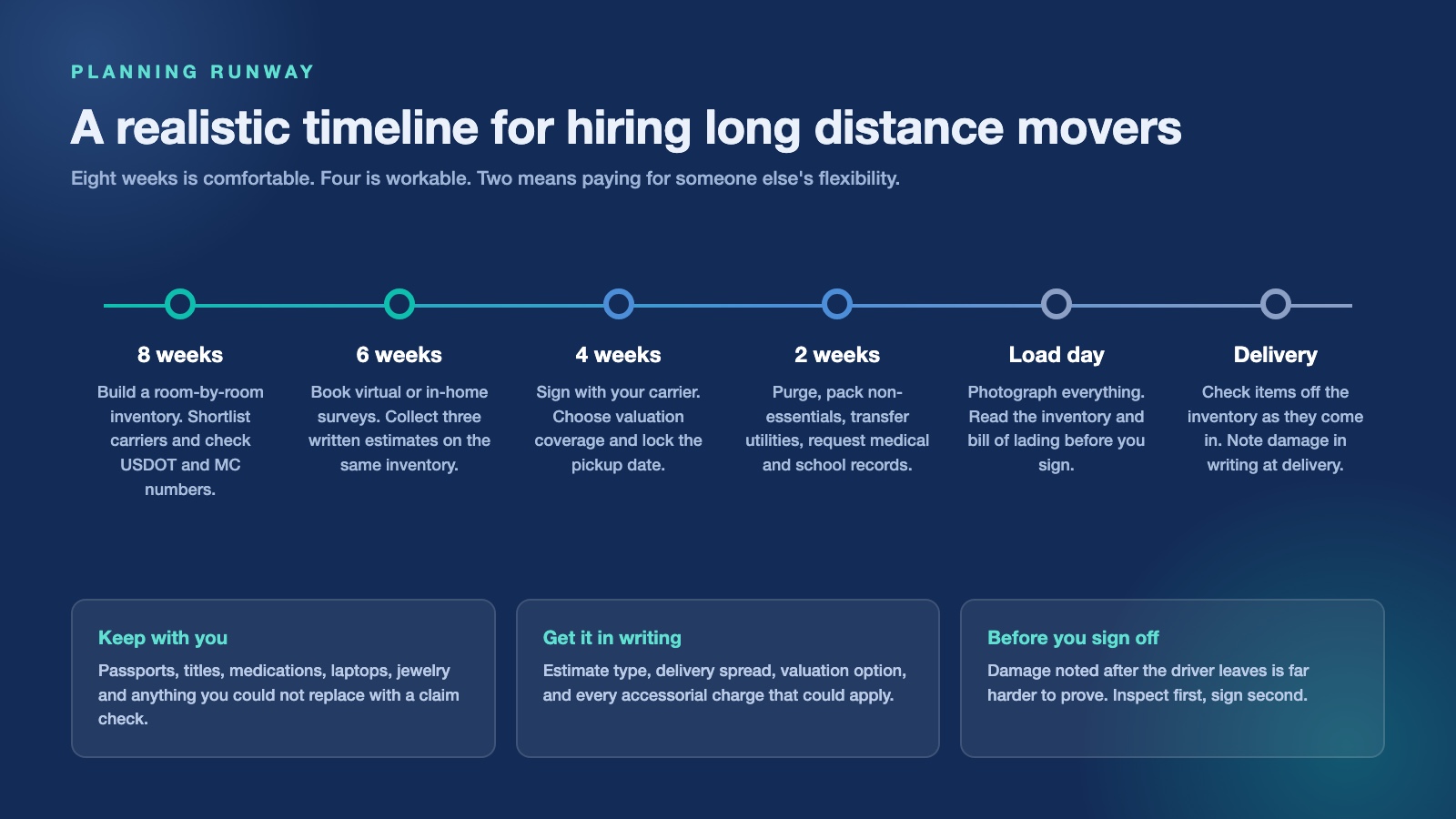
Two moments on that timeline carry more weight than the rest. The first is load day, when you sign the inventory and the bill of lading: read the condition codes next to your furniture before you initial anything, and photograph the rooms and the larger pieces as they go onto the truck. The second is delivery, when items should be checked off the inventory as they come through the door and any damage noted in writing before the driver leaves. Damage reported after the truck has gone is still claimable, but it is considerably harder to prove.
Conclusion
Hiring long distance movers is a document exercise dressed up as a physical one. The truck, the crew and the miles are the visible part; the price you actually pay is determined by an inventory, an estimate type, a valuation election and a delivery spread, all of which are settled weeks before anyone lifts a box.
Do four things and most of the risk disappears. Verify the USDOT and MC numbers rather than trusting the branding. Get three written estimates built on the same complete inventory, and understand which type each one is. Choose valuation coverage deliberately, with the 60-cents-per-pound default clearly in mind. Read the bill of lading before you sign it, not after the truck has left.
Handle those and a long-distance move becomes what it should be: a logistics problem with a known cost and a known window, rather than an expensive lesson in the fine print.