- Why Property Management Services Follow the Calendar
- Winter: Freeze Protection, Furnaces and Year-End Books
- Spring: Pricing, Renewals and Getting Ahead of Leasing Season
- Summer: Turnovers, Screening and Move-Ins
- Fall: Inspections, Winterization and Lease-End Strategy
- The Monthly Rhythm: Rent Collection and Eviction Protection
- Questions to Ask About a Manager's Annual Plan
Most descriptions of property management read like a menu of services. Landlords experience them as a calendar. The furnace quits on the coldest night in January, the sprinkler lines need blowing out before the first hard freeze, the strongest applicants appear in May, and the year-end books are due whether every tenant paid on time or not. First Command Property Management, a Meridian Property Management company serving owners across the Treasure Valley, built its approach around simplifying exactly that cycle: marketing, tenant screening, rent collection, maintenance coordination, financial reporting, inspections, and eviction protection run as one disciplined, results-driven system. The aim is not to do more tasks but to do the right ones at the right moment, which is how landlords protect their investments, improve profitability, and keep rentals secure and well managed from one season to the next.
This guide follows a typical single-family rental in Boise, Meridian, Nampa, Eagle, Star, or Kuna through a full year. It shows what professional property management services handle in each season, why timing matters as much as execution, and what an owner should expect to see from a manager along the way.
Why Property Management Services Follow the Calendar
Two forces shape the year for a Treasure Valley rental: the climate and the leasing market.
The climate is high desert. Winters bring hard freezes and the occasional stretch of single-digit nights; summers are hot and dry, with highs regularly in the 90s and some weeks above 100. Between them sit two short shoulder seasons when most preventive work has to happen. A furnace serviced in October is a routine appointment. The same furnace failing in January is an emergency call during the busiest week of an HVAC company’s year.
The leasing market has a rhythm of its own. Demand builds through spring and peaks from late May through August, when families move between school years, new hires relocate to a fast-growing region, and military households move on summer orders. It thins out from November through February. A home that comes vacant in December usually sits longer and leases for less than the same home listed in June.
Good management works with both forces instead of reacting to them. A handful of decisions made early, such as when leases end, when maintenance is scheduled, and when rent is reviewed, pay off for the rest of the year.
Winter: Freeze Protection, Furnaces and Year-End Books
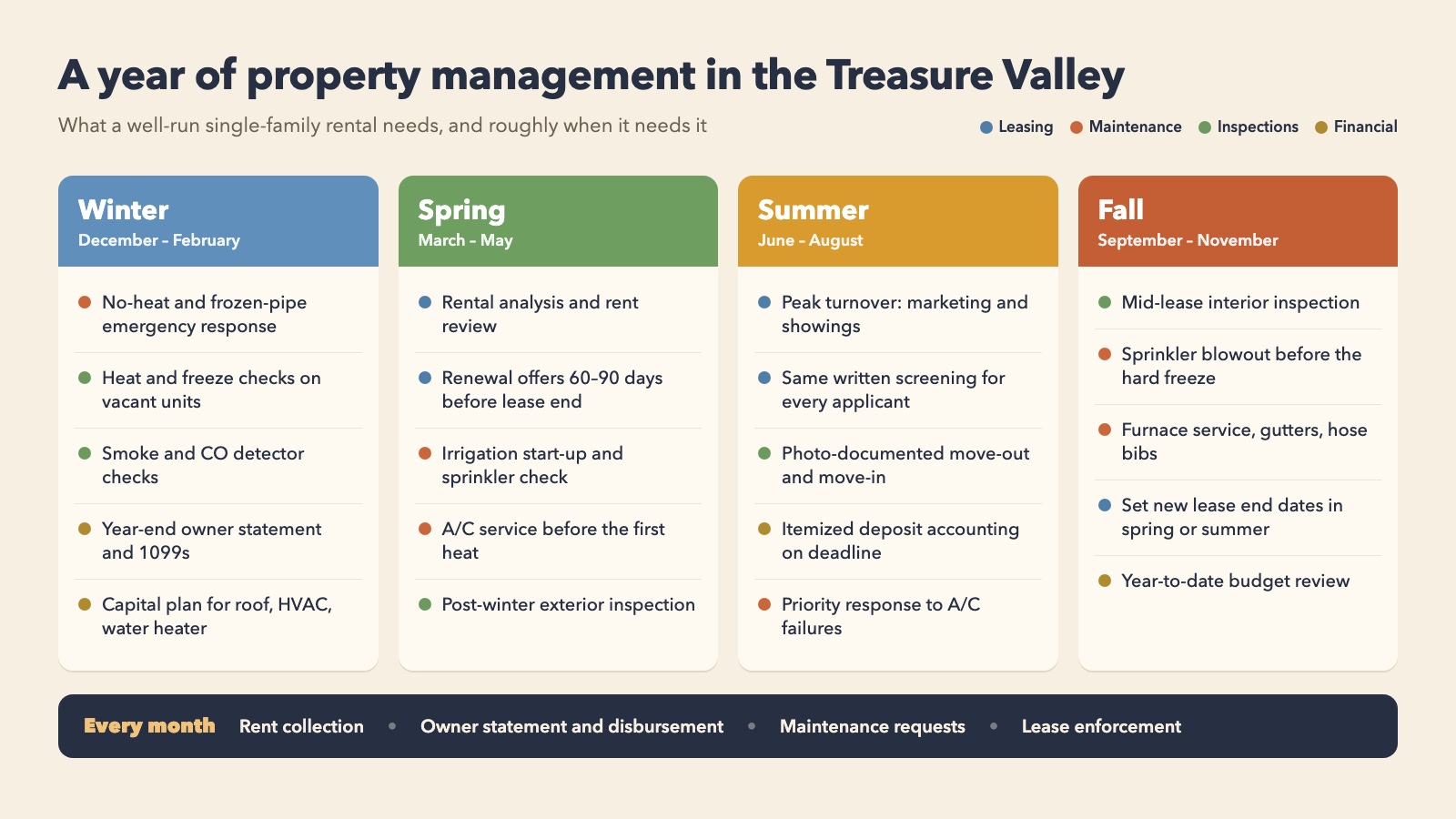
December through February is the quietest leasing season and the most demanding for maintenance response. Three things deserve attention.
Heat is an emergency, not an inconvenience. A tenant without heat in a Treasure Valley January is not just uncomfortable; the house is at risk. Frozen supply lines in exterior walls, crawlspaces, and garages can split and flood a home in hours. A professional manager has HVAC and plumbing vendors lined up before the cold arrives, a 24/7 intake path for genuine emergencies, and clear instructions for tenants on what to do while help is on the way. That preparation is what separates a same-night repair from a three-day wait and a water-damage claim.
Vacant units need active protection. An empty rental in winter should have the heat held at a safe minimum, periodic walk-throughs, and a documented decision about whether to shut off the water. Insurance policies often have vacancy conditions, and a burst pipe in an unoccupied house can run unnoticed for days.
Tenants need reminders before cold snaps. A short message before a hard freeze, covering keeping the heat on while traveling, disconnecting garden hoses, and opening cabinet doors on exterior walls, costs nothing and prevents a surprising number of calls. The lease should also be explicit about snow and ice on walkways and driveways. In single-family rentals that responsibility often sits with the tenant; in multifamily properties it usually stays with the owner. Ambiguity here is a liability problem, not just a housekeeping one.
Winter is also when financial reporting proves its value. A year of clean monthly owner statements becomes a year-end package: total rent collected, every maintenance invoice, management and leasing fees, net disbursements, and the forms needed for tax preparation. Owners who receive that package in January file with every deductible expense documented. It is also the right moment for a capital plan. If the water heater is twelve years old and the roof is approaching the end of its service life, the time to budget for replacement is before either fails, not after.
Interior inspections carry on through winter where the lease allows. Smoke and carbon monoxide detectors deserve particular attention in homes with gas furnaces, and bathroom ventilation is worth checking while condensation and mold are most likely to show up.
Spring: Pricing, Renewals and Getting Ahead of Leasing Season
March through May is when the year’s leasing results are largely decided, even though most move-ins happen later.
Rent review starts with data. The Treasure Valley’s growth has made rents unusually dynamic. Some years they climbed quickly; in others, a wave of new apartment supply in Meridian and Boise softened pricing for older units. A rental analysis based on current comparable listings, not last year’s number or a national average, tells an owner where the property actually sits. Priced too high, a home sits empty while mortgage, taxes, and insurance keep running. Priced too low, it locks in a below-market rent for the whole lease term.
Renewal decisions happen 60 to 90 days out. For a tenant who pays on time and looks after the home, a renewal at a market-informed rent is usually the most profitable outcome available. Turnover means vacancy days, cleaning, paint, repairs, a leasing fee, and the risk that the next tenant is not as good. Idaho does not allow cities or counties to impose rent control, so the practical limits on an increase are the market and the lease itself: a fixed-term lease generally cannot be changed until it expires, and an increase still requires proper written notice. Starting the conversation early gives both sides time to decide.
Irrigation comes back on. Many Treasure Valley subdivisions, particularly in Meridian, Nampa, Kuna, and Star, run on pressurized irrigation fed by canal water rather than the drinking-water supply. When the season starts, usually in April, systems need to be checked for heads cracked over winter, leaking valves, and timers that were never reset. The lease should state plainly who is responsible for watering and for the lawn’s condition. A dead lawn at move-out is one of the most common and most avoidable security deposit disputes.
Cooling gets serviced before it is needed. An air-conditioning tune-up in April or May costs a fraction of an emergency call during the first 100-degree week, when every HVAC contractor in the valley is booked solid.
The exterior gets a post-winter look. Missing shingles, gutters pulled loose by ice, fence panels damaged by wind, and soil settling against the foundation all show up after winter and are cheapest to fix while they are small.
Spring is also when listing photographs should be taken for any unit expected to turn over. A home photographed with a green lawn and leaves on the trees markets better than the same home photographed in February.
Summer: Turnovers, Screening and Move-Ins
June through August is peak season: the most applicants, the most move-outs, and the most pressure to move fast. The risk in summer is not a lack of demand. It is cutting corners because demand is high.
A well-run turnover begins well before the outgoing tenant hands back the keys.
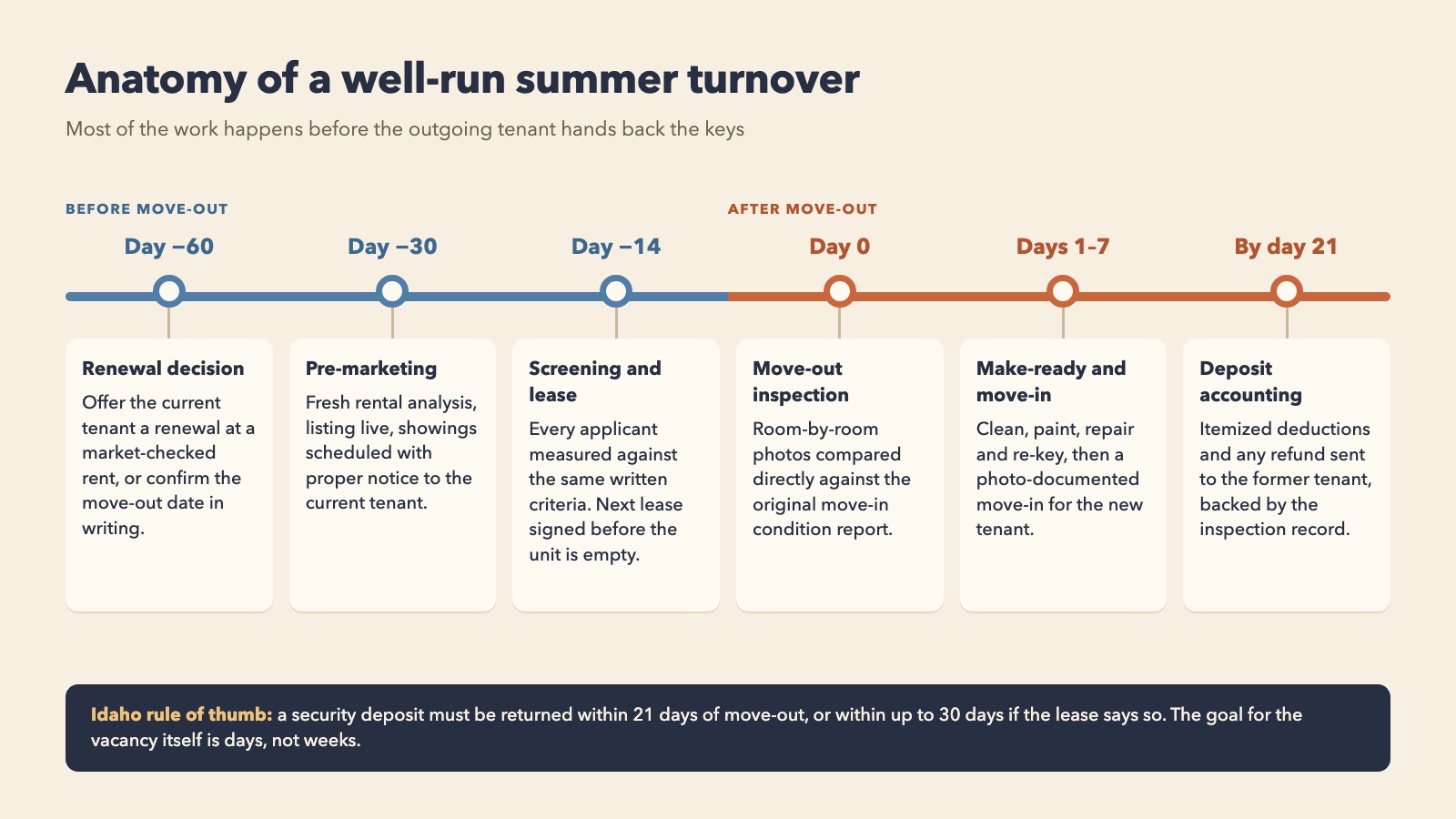
Marketing starts while the home is still occupied. With proper notice to the current tenant, showings can begin a month or so before move-out. The goal is a signed lease for the next tenant before the unit is empty, so the vacancy is measured in days rather than weeks.
Screening stays consistent under pressure. Summer volume makes it tempting to approve the first applicant who looks reasonable. A disciplined process applies the same written criteria to every applicant: identity and application verification, credit history, income measured against a stated rent-to-income ratio, employment, rental history and landlord references, and background and eviction records. Consistency matters twice over. It is what makes screening defensible under fair-housing rules, and it is what makes it effective. A single poorly screened tenancy can cost more than a year of the property’s net income.
Inspections protect the deposit decision. The move-out inspection should be compared room by room against the photographed move-in report from the start of the tenancy. That record is what allows legitimate deductions to stand if they are challenged. Under Idaho law, the security deposit, along with an itemized list of any deductions, is due back within 21 days of move-out, or within up to 30 days if the lease specifies a longer period. Missing that deadline in a busy summer is an unforced error.
Make-ready vendors are booked ahead. Cleaners, painters, and handymen are in demand across the valley in summer. A manager who schedules them as soon as the move-out date is confirmed avoids losing a week waiting for availability.
The new move-in sets the tone. A photo-documented condition report, utility transfer instructions, irrigation and yard expectations, and a clear explanation of how to submit maintenance requests give the new tenancy a clean start and create the baseline for the next move-out.
Summer heat also changes maintenance priorities. An air-conditioning failure during a heat wave is urgent, both for tenant safety and for retention. Tenants remember how quickly the AC was fixed when it comes time to decide whether to renew.
For owners who are themselves service members, summer is often when orders arrive. A homeowner leaving the area on short notice needs a manager who can take over leasing, inspections, and maintenance quickly, often from a standing start. First Command’s military property management offering is designed for exactly that situation.
Fall: Inspections, Winterization and Lease-End Strategy
September through November is the season owners most often overlook, and it is the one that sets up the following year.
Mid-lease inspections fit naturally here. Early fall is warm enough to assess the exterior properly and early enough to fix anything before winter. A periodic interior inspection confirms lease compliance on occupants, pets, and alterations, and surfaces maintenance problems tenants have not reported: a slow leak under a sink, a failing seal on a window, a dryer vent packed with lint. For owners who do not live nearby, it is often the only reliable view of the home’s actual condition.
Winterization is not optional. Irrigation districts typically shut off water in October, and sprinkler lines need to be blown out before the first hard freeze, or cracked pipes and valves turn into a spring repair bill. Hose bibs should be drained or covered, gutters cleared after leaf fall, the furnace serviced and the filter replaced, and weatherstripping checked on exterior doors. Whether these tasks fall to the owner or the tenant should be settled in the lease; whoever is responsible, a manager confirms they actually happen.
Lease end dates get set deliberately. This is one of the least visible and most profitable decisions in property management. A new lease signed in October or November should not automatically run for twelve months, because that schedules the next vacancy for the slowest leasing month of the year. An initial term of 15 or 18 months, or a shorter one that ends in late spring, moves the next turnover into peak season, when the home will lease faster and at a stronger rent. Done consistently, this alone can cut vacancy days across a portfolio.
The budget gets reviewed against the year so far. With three quarters of statements in hand, an owner and manager can compare actual maintenance spending against plan, flag recurring repair items, and decide what belongs in next year’s capital budget before the winter emergency season begins.
The Monthly Rhythm: Rent Collection and Eviction Protection
The seasons change what gets scheduled. They do not change the core of property management services, which runs on a monthly cycle: rent collected, maintenance requests triaged and closed, an owner statement issued, and proceeds disbursed.
Rent collection works best when it is boring. Online payment, a due date and grace period written into the lease, late fees applied automatically under the lease terms, and a documented follow-up path remove the personal friction that makes many self-managing owners hesitate. Because the process is the same for every tenant every month, it produces better on-time payment without turning each late payment into a negotiation.
When rent goes unpaid despite that process, procedure matters. In Idaho, a landlord generally must serve a written three-day notice to pay rent or vacate before filing an eviction for nonpayment. A defective notice, a miscounted deadline, or missing documentation can send the case back to the start while the unit produces no income. A professional manager handles the notice correctly, keeps the payment and communication record that the case depends on, coordinates with an attorney when filing becomes necessary, and follows through to re-leasing.
Eviction protection has a preventive side too. Most of it is the screening done in summer and the consistent follow-up done every month. First Command adds a financial backstop: its Risk Mitigation Guarantee reimburses qualifying eviction costs and pet-related damage that exceed the security deposit, up to a set limit per lease, according to the company. The company also says it charges no leasing fee until a lease is signed and the tenant’s initial funds are received, waives the leasing fee for a replacement if a placed tenant breaks the lease in the first year, and lets either party end the management agreement with 30 days’ written notice. Guarantees like these are worth asking any manager about, because they show where the company is willing to share the risk.
Questions to Ask About a Manager’s Annual Plan
Most comparisons between property managers focus on the fee percentage. A better test is whether the manager can describe what will happen to your property over the next twelve months. Useful questions include:
- When do you start renewal conversations, and how do you decide on a renewal rent?
- How do you set lease end dates for tenancies that start in the fall or winter?
- What is your winterization checklist, and who confirms it was done?
- How are after-hours no-heat and no-cooling calls handled, and which vendors respond?
- How often are inspections performed, in which months, and are they photo-documented?
- What does the year-end owner package include?
- What is the maintenance spending limit before my approval is required?
- What happens, and what is covered, if a tenant you placed defaults or has to be evicted?
- How do I end the agreement if it is not working, and is there a penalty?
Clear, specific answers point to a manager running a process. Vague ones point to a manager reacting to whatever comes up. Owners who want to see how a structured plan would apply to their own home, including its rent position, its lease dates, and its maintenance history, can start with a Property Management Consultation. First Command also publishes free tools on its site, including a rental analysis and a vacancy loss calculator, which are useful for testing your current numbers before any conversation.
Local depth matters alongside the paperwork. A manager who knows how rents differ between a newer Meridian subdivision and an older Boise neighborhood, understands pressurized irrigation and the valley’s freeze cycle, and already has working relationships with dependable local trades will price more accurately, respond faster, and catch problems a distant or generalist firm would miss.
Conclusion
The difference between an average rental and a well-performing one is rarely a single big decision. It is dozens of small ones made at the right time: a renewal offered in March instead of a vacancy in July, a sprinkler blowout in October instead of a cracked manifold in April, a lease that ends in June instead of December, a deposit accounted for on day 18 instead of day 35.
That is what professional property management services deliver when they are done well. Marketing and screening keep strong tenants in place, structured collection and reporting keep the finances legible, coordinated maintenance and documented inspections protect the physical asset, and disciplined procedure limits exposure when something goes wrong. For Treasure Valley landlords, running all of that on a seasonal plan rather than a reactive one is what turns rental ownership into an investment you can plan around.